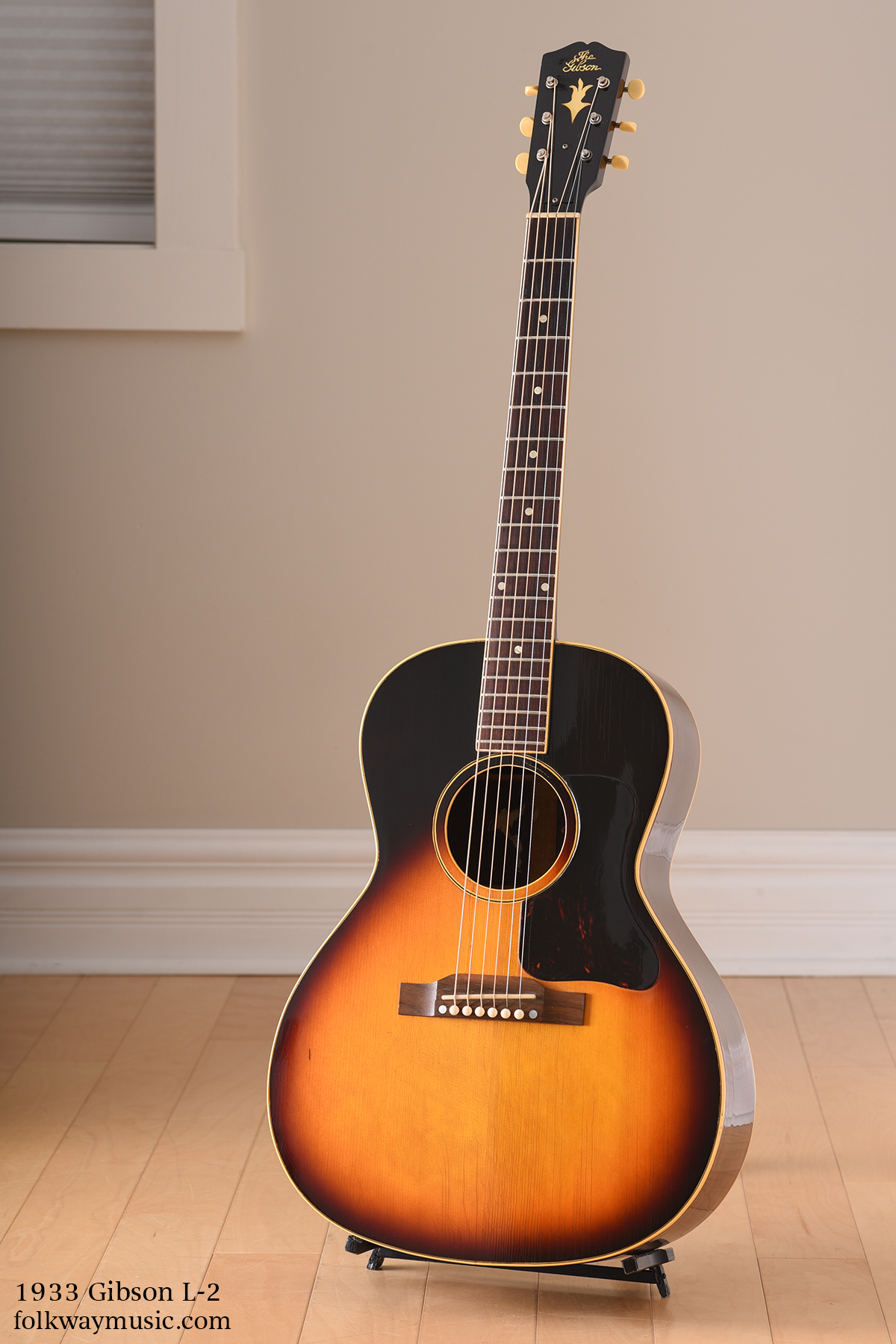
1933 Gibson L-2
$26,272.70 CAD
(USD $17,995.00)
For more details contact us at info@folkwaymusic.com or 855-772-0424.
Gibson’s 14 fret Brazilian rosewood L-2 was a very short-lived model that was built in exceptionally limited numbers in late 1932 and early 1933. It replaced the 13 fret-version that was spec’d with an archtop style trapeze tailpiece and floating adjustable bridge that was produced in 1931 (which in turn replaced the “Gold Sparkle” versions from 1930).
There are 4 known and recorded FONs of 14 fret rosewood L-2s. We’ve personally encountered guitars from two of these FON batches (453 and 514). The other two FONs are listed in Joe Spann’s FON reference (353 and 512) and FON 353 is cross-referenced as 14 fret rosewood L-2s in research collected by the late André Duchossoir. Between Joe, André and us here at Folkway less than 10 of the 14 fret rosewood L-2s have been accounted for, and that number might be more like 6. Suffice to say, this is a rare model.
This particular Brazilian rosewood 14 fret Gibson L-2 recently turned up from the family of its original owner. Looking at these photos, it will seem obvious to some of you that the guitar went back to Gibson in the late 1950s for a refinish. But, much less obvious, is that this guitar actually went back to Kalamazoo for repairs twice – the first time being 20 years earlier when it was retopped. Added up, you’re looking at a 14 fret L-2 model that was made in early 1933, was retopped in around 1940, and then restored in 1959 or 1960 when it received a new fretboard, bridge, and pickguard, a refinish, and new nut, saddle, and bridge pins.
And how do we know all of this? Comparative anatomy and experience. This isn’t our first rodeo when it comes to vintage Gibson forensics.
The current top’s original bridgeplate is intact and had two sets of pin-holes prior to our restoration of it. Both sets were spaced at roughly 2-1/8”. The braces and bridgeplate were quite clearly pre-WWII (saw marks, shape, dimensions, hide glue, & layout). Those braces and 2-1/8” pins spacing point only to the very early 1940s.
The color and thickness of the refinish is typical of the late 1950s into 1960. The nut and saddle material is the same woven micarta that Gibson used for saddles from about 1958 on (and nuts from 1964). They didn’t have injection-molded nylon nuts in 1-3/4” widths, so any odd sized nut required hand-slotting, and after 1958, woven micarta was used in place of bone for that job. The fretwire is late 1959 spec and is original to the fretboard, complete with matching binding nubs. Finally, the belly-up bridge has late 1950s tooling marks and its original saddle is glued in, as was the norm.
So that brings us to the end of the Gibson guitar forensic dating lesson. Now on to the guitar!
This L-2 has a unique voice among 1930s Gibsons as it’s a sum of parts that never existed as a standard model. Straight-braced late 1930s L-00 top construction, early 1930s Brazilian rosewood back and sides, and 1950s belly-up bridge. It adds up to a guitar that is loosely like a later 1930s L-00, but with less brashness and clang and more smoothness as well as a rounded, slightly compressed dark voice. It’s really well suited for fingerstyle and medium-weight strumming. This might be odd, but imagine if a late 1940s LG-2 and 1950s Martin 000-28 were somehow joined into one guitar. That’s what this L-2 (sort of) sounds like. It’s more pretty sounding than it is aggressive and barky, and offers a sweet mid-range, rounded and full trebles, and defined expressiveness in the lows.
The guitar’s top and back are crack free. There are a few very minor side cracks that have been glued. The braces are all tightly glued and there are no messy repairs. There is minor scarring on the underside of the top from where there was once an extra bridgeplate glued behind the original (1950s factory work, but it really didn’t need to be there so we removed it). The original late 1950s finish is in exceptional condition; suggesting the guitar was barely used when it was returned from Gibson in 1959 or 1960. There is minor water damage to the finish at the very bottom of the guitar that matches the water damage on the original case. The original 1959 frets show very little wear, the nut has never been removed, and the saddle is full height. The original late 1950s bridge pins were shrunken and have been replaced. There was a DeArmond pickup in the soundhole which has been removed, the endpin hole fits a contemporary ½” jack. Original early 1930s tuners work well.
Nut width is 1-3/4”, soft V neck carve with 1st fret thickness of .935”. 2-1/8” string spread at the saddle, 24.75” scale. The action is set at 5-6 64ths with 12-53 strings.
With damaged original hardshell case.